


Articles
These Bizarre International Comics Gave Spider-Man Fans Something They Really Wanted (& The Reason Why Is Wild)

Today, it’s hardly unusual to see an alternate version of Spider-Man. Beginning in 1977 with the first issue of What If … ? Marvel invited readers to imagine alternate timelines and different scenarios for their favorite heroes and villains. Few were more appealing than Spider-Man, who invited speculation like “What If Spider-Man Joined the Fantastic Four?”, “What If Someone Else Had Been Bitten By the Radioactive Spider?”, and “What If Spider-Man’s Clone Had Lived?” And while all of these scenarios later came to pass in Marvel’s mainline continuity, one heart-breaking alternate timeline has remained conjecture: “What If Spider-Man Had Rescued Gwen Stacy?” Published in 1980, What If … ? #24 was neither the first nor the last time Marvel would revisit “The Night Gwen Stacy Died,” the character-defining story that appeared in Amazing Spider-Man #121. Unless, of course, you were a Mexican fan of Spider-Man in the seventies, in which case Gwen Stacy never died.
In the 1960s, 70s, and even into the 80s, Marvel had a looser grip on international licensing. Most famously, this led to Toei’s bonkers Spider-Man Tokusatsu series, which featured an Ultraman-style reimagining of the wallcrawler with a giant mech and a machine gun at his side. Less well known, but just as bizarre, were the stories published by Mexican comic company La Prensa, the international distributor of Spider-Man in the early seventies. Spidey was a hit with Mexican audiences, so much so that La Prensa was rapidly running out of material to reprint. Their solution was, with dubious permission from Marvel, to write all-new Spider-Man stories to fill in the gaps. These new stories enabled La Prensa to tailor storylines to the taste of Mexican readers, which varied from those of American fans. Most notably, Mexican Spider-Man fans loved Gwen Stacy, whose role was inflated for the La Prensa originals. And no issue changed Peter Parker and Gwen Stacy’s relationship more than El Sorprendente Hombre-Araña #128, which features a dream sequence where the couple marry. Next week, Heritage is set to auction the highest-grade copy of the issue in the world, and the price has already reached $30k.
How Mexican Readers Ended Up With an Alternate Spider-Man Timeline
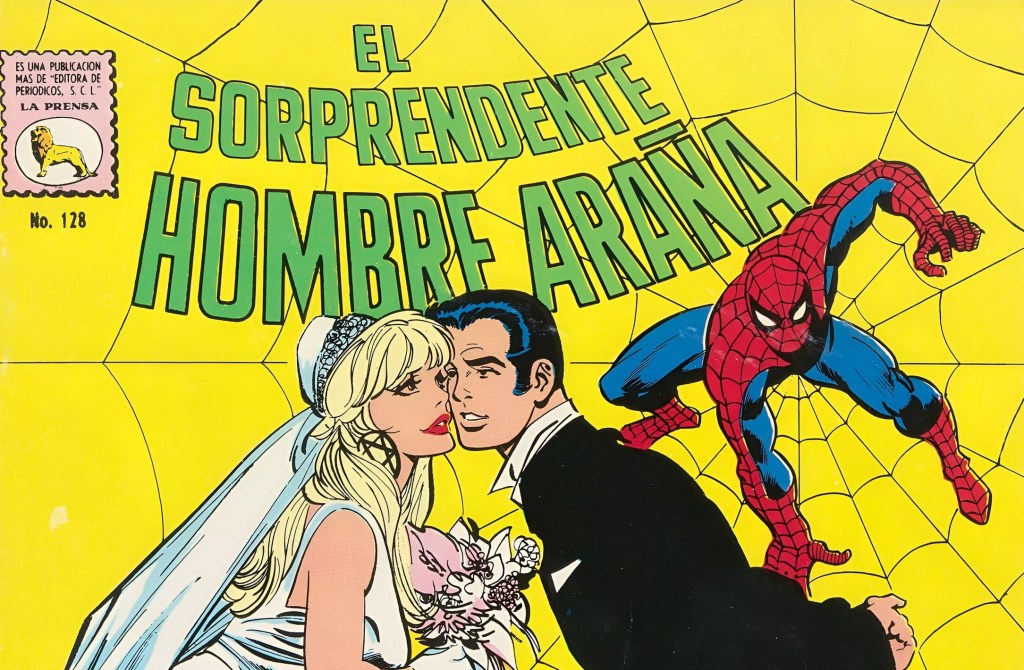
Beginning in the mid-sixties, Marvel Comics were licensed the world over, translated into new languages, and turned highly-collectible international variants. Such was the case with La Prensa, who found themselves rapidly burning through the hundred-and-ten odd issues of Amazing Spider-Man with their bi-monthly publication of Sorprendente Hombre-Araña. Somehow, their editor-in-chief obtained permission from Stan Lee to create all-new Spider-Man stories for the Mexican market, sandwiched between reprints of the American comic. Artist Jose Luis Gonzalez-Duran was selected to pencil the Mexican stories, written by Raul Martinez. To meet the demanding bi-monthly publishing deadline, Gonzalez-Duran’s art and covers are often taken from American comics, leading to cover appearances by characters like Vampirella or even Batman villains.
After “The Night Gwen Stacy Died” was published in 1973, La Prensa chose to switch entirely to publishing new stories instead of reprinting the American comics. As stated, Gwen Stacy was extremely popular with Sorprendente Hombre-Araña readers, and the publisher felt killing her off might seriously hurt sales. The result was forty-five original stories, creating an alternate Spider-Man timeline where Peter Parker and Gwen Stacy remained together and happy. Another consequence was that Norman Osborn was never killed, and remained the sole Green Goblin in La Prensa’s Spider-Man comics. Sorprendente Hombre-Araña ran until 1974, when La Prensa closed its doors and ended the series with issue #185. For comparison, Marvel wouldn’t publish Amazing Spider-Man #185 until 1979, featuring Peter Parker’s (almost) graduation from Empire State University, colored melancholy by his recent break-up with Mary Jane Watson.
It’s important to note that Gwen Stacy and Peter Parker didn’t actually marry in the La Prensa timeline. The cover of Sorprendente Hombre-Araña is a misdirect, akin to all those Silver Age Superman stories where Superman finally marries Lois Lane. The wedding is confined to a dream sequence, while the issue itself (in another ironic twist), sees Norman Osborn return to his alter-ego of the Green Goblin. Misinformation around the issue has become widespread as it has never been reprinted — in English or in Spanish — and most American fans have only seen its cover. Some interior pages can be found online, though for the complete story, a fan would have to track down the issue itself.
Another publisher would take over Mexican publishing rights to the character from La Prensa, OEPISA (Organización Editorial de Publicaciones e Impresiones SA), beginning in 1974. OEPISA continued to work with Gonzalez-Duran to publish new Spider-Man stories, this time without Marvel’s expressed permission. There’s even less information about this era, which featured stories called Arañita Super Histories, centered around a younger Peter Parker. Ignoring continuity, Gwen Stacy is part of these pre-college adventures, the first time a writer re-imagined Gwen as a part of Peter’s life prior to Empire State University. One article on these comics likens them to DC’s Superboy title, documenting “the Adventures of Superman When He Was a Boy.” These ended in 1979, and no new regional distributor emerged to take OEPISA’s place. Going into the eighties, Marvel became more concerned with maintaining a cohesive brand identity, and the practice of regionalizing comics was largely discontinued.
Why Fans Are Fascinated By Mexico’s Spider-Man Comics

To this day, “The Death of Gwen Stacy” is regarded by fans as not only one of the most important Spider-Man stories ever told, but as one of the most important comics ever written. It marked the transition from the Silver Age to the Bronze Age, a time when Marvel and DC’s comics began to reflect the tumultuous, ambiguous real world. Gwen Stacy’s death marked one of the first times a major Marvel character died and stayed dead (the only comparable event to this point was her father’s death in Amazing Spider-Man #90). She had been a fixture of Spider-Man since 1965, and with her demise, readers found that the rules of the medium had changed: Spider-Man couldn’t always save the people he loved, and he had to learn how to live with that. Watching Peter Parker work through that grief was a years-long process, and it pushed his character in new directions — including toward his relationship with Mary Jane, the love of his life. Even today, we still see Peter grappling with guilt over Gwen’s death. It’s arguably the most foundational moment his character has had besides Uncle Ben’s death and the spider bite that started it all.
Spider-Man’s adventures in Sorprendente Hombre-Araña function as an extended issue of What If … ? that lets fans explore how things would be different if Gwen never died. The comics are almost stuck in the Silver Age, featuring a less mature, less contemplative Peter Parker. The stakes are lower, the danger feels distant and impersonal. Even though Peter and Gwen’s wedding in #128 is a dream sequence, it feels like a development that would have happened for real, given enough time. As it is, the wide-spread misinterpretation of the comic is emblematic of exactly why it holds such fascination for Spider-Man fans: it’s the “road not taken” for one of the most critical moments in the character’s history. And owning the tangible representation of what could have been is worth at least $30k to one fan. With more than a week left to bid, and the next bid set for $36k by Heritage, it looks as if the comic might be worth much more — it’s already more than triple the record sale price of Amazing Spider-Man #121, set by Heritage at $9.3k in 2021.
