


Articles
This Oscar-Winning Thriller Is Best Known for Its Gritty Violence, But It’s Secretly Really Funny Too

Joel and Ethan Coen’s 2007 masterpiece No Country for Old Men is often considered to be one of the best films of the 2000s, and is remembered for its tension, violence, and drama. It is arguably the best adaptation of one of Cormac McCarthy’s works, and it is easily one of the best modern Westerns. The film won Best Picture and three other Academy Awards, and it has even been chosen to be preserved in the Library of Congress’ National Film Registry, yet it still is underappreciated for one major reason.
No Country for Old Men tells the story of a hunter named Llewelyn Moss who, while out hunting, discovers a briefcase containing $2 million in cash. His decision to take the case gets him in trouble when psychopathic killer Anton Chigurh is hired by a drug dealer to recover the money, only for both men to be pursued by Sheriff Ed Tom Bell. Throughout the film, blood is shed, lives are lost, and surprisingly, many laughs are had.
No Country for Old Men Is Really Violent, But It’s Also Super Funny
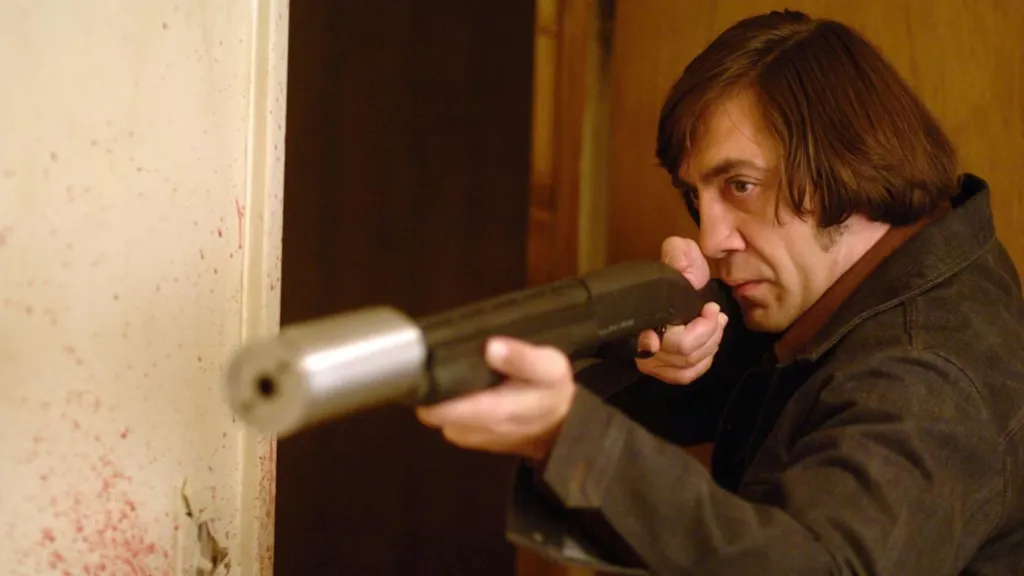
Likely due to how violent and tense No Country for Old Men is, audiences and critics alike don’t give the film its due credit for how funny it is. The story is full of moments of dry comedy, and while these aren’t the most memorable scenes of the movie, they are what elevate some of its most iconic interactions. For example, the encounter between Chigurh and the gas station clerk, in which the killer decides the life of the latter based on a coin flip, manages to be both incredibly funny and tense, and that’s all thanks to the dryly comedic writing and the performances of Javier Bardem and Gene Jones.
On top of that, the film is full of incredibly funny lines that act as brief moments of levity among horrific scenes. Another example: just after Carson Wells is killed, Moss asks if he is there while on the phone with Chigurh, to which the killer replies, “Not in the sense that you mean.” Similarly, Moss’ “You have a lotta people come in here without any clothes on?” after entering a store in just a robe and Sheriff Bell’s “What we circulate? Lookin’ for a man who has recently drunk milk?” after discovering Chigurh’s still-cold glass bring a laugh even during the intense game of cat and mouse.
No Country for Old Men‘s humor serves a larger purpose than just being funny, as it also strongly defines the main three characters and how their relationship evolves in an ever-changing world. So, Chigurh’s humorous comments highlight his detachment from the horrors he commits, while Sheriff Bell’s jokes show how he feels like an old-timer in a world that left him behind, and Moss’ comedic situations showcase his hubris that ultimately leads to his downfall. Perceived lack of agency, detachment, and arrogance are all supported by No Country for Old Men‘s humor – and the Coen brothers clearly made a conscious decision to explore these themes through comedy.
It Isn’t Surprising That The Coen Brothers’ Comedic Past Leaked Into Their 2007 Drama

No Country for Old Men is by far the most dramatic film in the Coen brothers’ filmography, and this tonal shift was incredibly surprising based on the duo’s films up to that point. Movies like Raising Arizona, The Hudsucker Proxy, and The Big Lebowski are straight-up comedies, while other mixed-genre films like Barton Fink, Fargo, and O Brother, Where Art Thou? could easily be described with the “comedy” label. Crime films Blood Simple and Miller’s Crossing are closer in tone to No Country for Old Men than some of the Coens’ other works, but even they are far less grim than the 2007 masterpiece.
So, it isn’t shocking that some comedy leaked into the script of No Country for Old Men, despite how serious the overall movie is. After all, it would feel unrealistic for characters like these to never crack a joke or offer a moment of levity, and since the Coens are so good at writing these elements, they feel at home in this script. No Country for Old Men definitely isn’t a comedy, but it doesn’t get enough recognition for how its sparse comedic moments support the rest of the film, which is why it is both the best movie by the Coens and the black sheep of their filmography.
