


Articles
25 Years Ago, a Cult-Favorite TV Show Laid the Groundwork for J.J. Abrams’ Star Wars & It’s The Better Story

Say what you will about the most recent Star Wars trilogy, but The Force Awakens was a genuinely exciting moment for the franchise. J.J. Abrams’ 2015 film introduced a new era of Star Wars to a fresh generation of fans to this iconic world and gave us characters that we are still interested in more than a decade later with Rey, Finn, and Poe. Things may have come a bit unglued — Rian Johnson’s The Last Jedi remains divisive and there’s a good deal of criticism to be had for Abrams’ return for The Rise of Skywalker — but The Force Awakens was a good moment for the franchise. But while The Force Awakens was far from Abrams’ first attempt at a huge franchise film, it’s a project that owes a lot to something much, much smaller, an underrated television series that paved the way for the director’s journey to a galaxy far, far away.
25 years ago, Alias debuted on ABC. The series starred Jennifer Garner as Sydney Bristow, a double agent for the CIA working to take down the global criminal espionage organization SD-6. The series, which ultimately ran for five seasons (of which Abrams, who created the series, served as showrunner for just the first three) on the surface may not seem like it would have all that much in common with Star Wars or have any real impact on the much larger and more well-known franchise, but a closer look at the cult classic series shows that Abrams was establishing the blueprint that would help flesh out The Force Awakens — and it might make you look at Alias a bit differently.
Abrams Perfected His Mystery Box on Alias Before Taking it to a Galaxy Far, Far Away
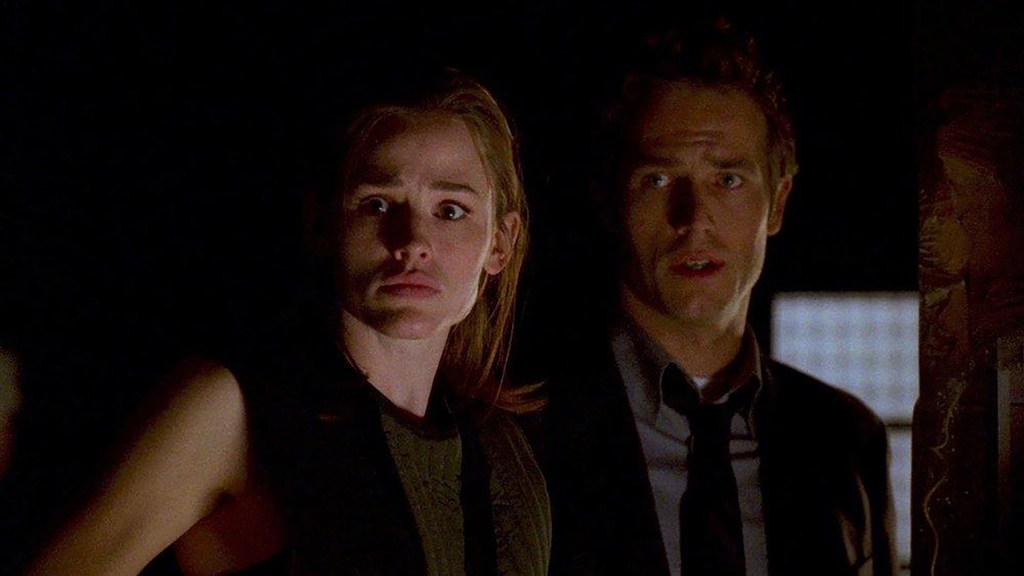
One of the biggest elements to emerge from Alias was the “mystery box” storytelling framework. The ABC series thrived on it, starting out simply as a spy thriller but quickly centering around a much larger puzzle — the mysterious 15th century prophet and inventor Milo Rambaldi and his doomsday prophecies and devices. Even as Sydney was working to take down SD-6, dealing with those artifacts (and specifically gathering them before someone else could) was a huge part of the story. Those elements were themselves layered with other mysteries when it was revealed that Sydney herself may be part of the prophecy and that her own family history was much, much more entangled in Rambaldi than anyone could have guessed. It made for a delicious hook that kept fans glued to each episode, but there was another element that really engaged viewers. Even as Sydney was dealing with these artifacts and the ongoing mystery, she was also dealing with her identity. Season 1 saw a pretty big reveal about Sydney’s late mother that caused her to question everything. The question of “who am I?” was a big part of the Alias story.
Now, flash forward from 2001 when Alias debuted to 2015 when The Force Awakens hit theaters and you’ll find a lot of similarities. There is a mission to find Luke Skywalker by resistance pilot Poe Dameron that ends up bringing into things a disillusioned stormtrooper, Finn, and ultimately a young scavenger named Rey whose childhood is a bit of a mystery. On the journey, it becomes clear that there is something different about Rey when The Force draws her to the location of Anakin’s lightsaber. The story is different — Alias is trying to take down a spy agency and deal with an ancient prophet while Star Wars is ultimately trying to take down the Empire — but the elements are the same. Each element of Rey and company’s journey in The Force Awakens opens up a new mystery and the whole time the audience and Rey herself is left wondering exactly who she is and why the Force seems to be strong with this one. Sydney Bristow was the test case. Rey was the final form.
Alias Remains Arguably Better Than The Force Awakens

There is no denying that The Force Awakens is a solid Star Wars entry, but more than a decade on it’s easy to see some of the weaknesses in the overall film and the trilogy overall. That includes just how much mystery the film asks fan to invest in versus what it can actually explore. While Abrams is able to do quite a bit with the mystery box format on the big screen, it ultimately runs out of space. The Force Awakens has just around two hours to do its work as well as set the stage for the next film in the series, which pushes the movie into a very tight, unforgiving pace. There’s no real space to go deeper into certain elements of Rey’s story or really let audiences get a full grasp on just how significant the stakes are. A lot of things are assumed or even hand-waved away for the sake of continuing the story at speed. Alias, in contrast, is able to slow burn many of the mysteries episode to episode, season to season. Even with Abrams stepping away as showrunner to do Lost, the series is able to continue to unfold Sydney’s mystery story in a way that feels organic.
This organic build up leads to a story that, when the payoff finally arrives even though there are certainly criticisms to be had for how Alias ends, there is something satisfying about it. Alias is able, because of time, to give Sydney something that Star Wars struggles and ultimately fails to give Rey: a fully realized journey of self. You see Sydney fully know who she is and what she wants and how she is willing to get it. You never really get to have that with Rey. The Force Awakens leaves her trying to hand off a lightsaber to Luke and then, when Abrams returns to the trilogy for The Rise of Skywalker, sees her assume an identity that doesn’t really feel earned. To put it a different way, Alias opens all of its mystery boxes to expose what is inside. The Force Awakens — and by extension, The Rise of Skywalker — leaves many of them closed.
When you look at both Alias and The Force Awakens, it’s clear to see how one follows the other, but it is also clear to see how one just works better than the other. Alias is an early, but effective, glimpse at a storytelling format that Abrams would make wide use of on the big screen. The Force Awakens did it bigger and leveraged it to spark new interest in Star Wars, but Alias really used the mystery box to the fullest. A quarter of a century on, the series is still worth revisiting. And who knows, you might just come away with a new appreciation for Star Wars and Rey in the process.
