


Articles
You’ll Never Watch Silence of the Lambs the Same Way After Noticing This Detail

When most people think about The Silence of the Lambs, they think about how good of a movie it is. written by Ted Tally and directed by Jonathan Demme, the 1991 adaptation of Thomas Harris’ novel of the same name is, without question, an incredible film. Jodie Foster delivers one of her best roles as FBI trainee Clarice Starling who is hunting serial killer Buffalo Bill (Ted Levine) and seeks out imprisoned serial murderer Hannibal Lecter (a chilling Anthony Hopkins in another career best role). The film routinely lands on lists of greatest films of all time still has the distinction of being the only horror movie to have ever won the Academy Award for Best Picture. And none of that even takes into consideration the cultural impact — after all, Hopkins’ delivery of the line about fava beans and a nice Chianti remains infamous decades later.
But for as great as The Silence of the Lambs is, there is also something very special about it in the way that it is framed. Demme is well-known for his use of dramatic close-ups in films along with characters looking directly into the camera and the style of The Silence of the Lambs certainly reflects that. It’s part of what makes the film unsettling. However, when you go just a little deeper, you realize that this isn’t just a stylistic choice on the part of the filmmaker. It’s a way of centering the story in the sexism and misogyny of society as experienced by Clarice without making it the main part of the plot. It does it smartly by making you, the viewer, experience the leering and male gaze for yourself, making the movie as much about the hunt for a predator as it is about the predators that are always watching.
Much of The Silence of the Lambs Is Shot to Offer Clarice’s Point of View
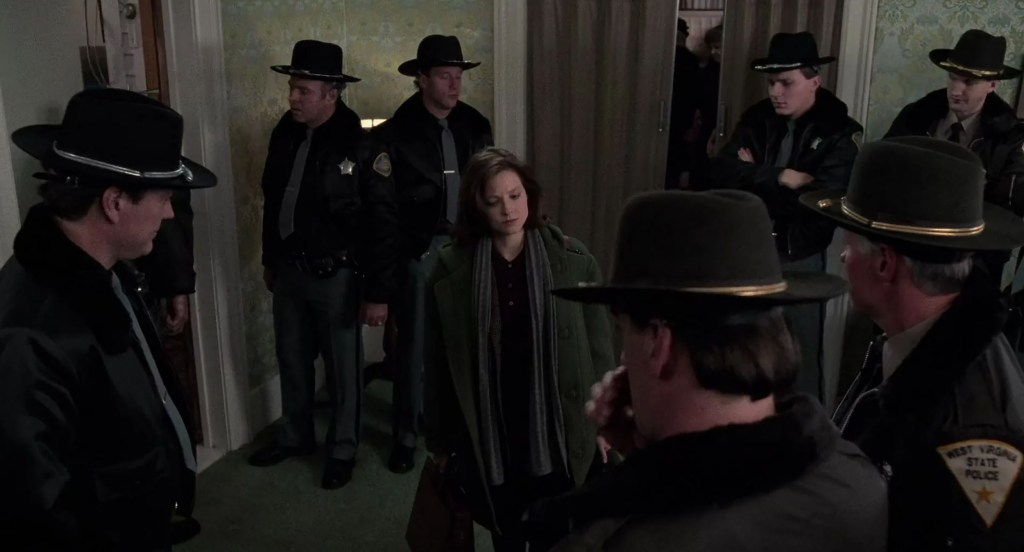
To achieve this unsettling sort of story within a story, Demme uses two interesting techniques. The first is the previously mentioned use of close-ups. Throughout the film, we get many characters speaking while looking either directly or very near the camera’s lens. This creates a sense of forced perspective as though the viewer is the person being spoken to and, in this case, with the characters frequently speaking to Clarice, it’s putting the viewer into her role and her point of view. It is at time very uncomfortable. Many of the characters addressing Clarice are openly hostile to the FBI trainee for simply no other reason than she is a young woman.
Beyond just that element of it, however, it’s the way shots in the film highlight exactly how the men in the movie look at Clarice. It is a serious challenge to watch The Silence of the Lambs and find a scene where a man is not leering at or objectifying Clarice. Eyes rake over her body, often followed by comments about her gender. There is almost no moment in the film where Clarice isn’t in some form the center of male attention. That includes Lecter, though he takes things to a more direct and blunt level by actually pushing Clarice’s buttons, suggesting that her boss is fantasizing about her and even, during the final encounter between them, directly asks her if she feels “eyes moving over your body”. Viewers have already, at this point in the film, witnessed those eyes all over her body and now it’s being directly called into sharp focus.
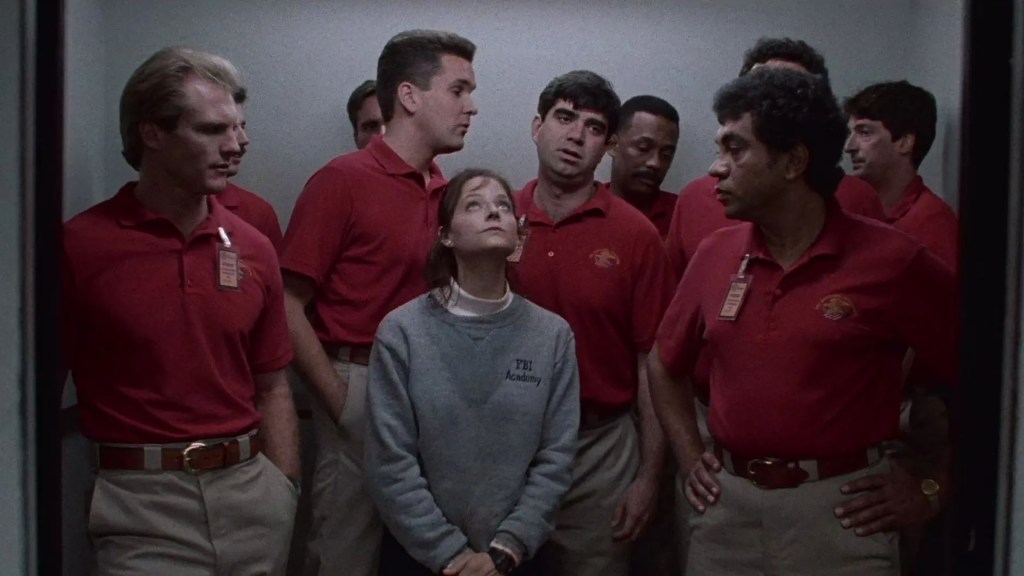
Even going beyond the way men speak to and look at Clarice in the film, there are other framings that drive home the uncomfortable reality of Clarice’s experience. Most people would point to the opening scene of the film in which Clarice is seen running an obstacle course at Quantico, alone, the suggestion being that even though she is very clearly training for the FBI, she is still a fragile woman. However, there is another scene that really drives home the idea of Clarice as prey and the man’s world she’s in as predatory. It’s the scene in the elevator — the one earlier in the movie, not the iconic one. That scene doesn’t really mean anything in the grand scheme, story-wise, but it’s how it’s framed. You have the very tiny Clarice in grey sweats surrounded by much larger men in red shirts. She is surrounded and many of them look down on her — literally — or look her over. It’s a little humorous in context; there is always a bit of comedy in the juxtaposition between tall and small — but it’s an uncomfortable humor. She looks like a lamb about to be devoured by wolves.
Demme’s Framing of The Silence of the Lambs Doesn’t Change the Story, It Just Makes it More Unsettling
I think that what makes the way The Silence of the Lambs is visually framed the most interesting is that it doesn’t change the way the story functions. The story would still be a taught, well-crafted horror thriller even if we didn’t see things through Clarice’s eyes or didn’t have the perspective of how much of the male gaze is fixed on Clarice at virtually every moment. We’d still have the complex, layered plot with all of its moving parts and sharp character terms. We’d still have Lecter manipulating Clarice and some truly psychologically intense scenes. But with the framing, we get that extra bit of horror. It’s the horror of the ordinary, that uncomfortable and unsettling knowledge that even as Clarice works to stop one evil predating on women, she — and by extension all women — are surrounded by even more. They may not be the sort that want to do as Buffalo Bill has done, but there’s still that suggestion of a woman’s body as object.
Watching The Silence of the Lambs with the way it’s made in mind, you won’t be able to see the film the same way. In a sense, it makes it better — and certainly cements its rightful place as one of the best movies ever made.
