


Articles
4 Things That Happen in Every Christopher Nolan Movie, Including The Dark Knight And The Odyssey

It’s hard to deny that Christopher Nolan is one of the best filmmakers of our time. He’s the third highest-grossing director of all time. He’s been nominated for eight Academy Awards and won two along with numerous other nominations (and wins) for awards such as the British Academy Film Awards, the Golden Globe Awards, and more. His films have ranged just about every genre you can imagine; he’s taken on original material as well as adaptations and consistently receives praise for complex storytelling — something impressive considering how many of his films are blockbusters that dominate the box office when they’re released. He is easily one of filmmaking’s greats.
But even with Nolan being a filmmaker with a diverse filmography that tells a wide range of stories in a career spanning more than 30 years, there are some elements in his work that you’ll find in everything he makes. While we could make a joke about the sound editing in Nolan’s films, the truth is that there are other, more interesting consistencies you’ll find when Nolan is behind the camera. Here are four elements you’ll find in every Nolan film — and that includes The Dark Knight and The Odyssey.
4) Practical Effects

This one is very much a no-brainer, but there is one thing that you will find in every Nolan movie is excellent use of practical effects. While the filmmaker doesn’t shy away from CGI as necessary, the truth is that most of the incredible moments — particularly with the action scenes — in his films are all practically done. The truck flipping over in The Dark Knight? That was done practically. The insane hallway fight scene in Inception? They did that with a special set that was built specifically to fully rotate 360 degrees. And then there’s the plane crashing into a building in Tenet, the bomb in Oppenheimer… you get my point.
What I think is really cool, however, is how Nolan brought the use of practical effects to The Odyssey. Of all his movies, this is the one that I think many fans would have assumed would lean more heavily on CGI. Instead, the filmmaker founds ways to use forced perspective among other techniques to deliver truly epic visuals, great action scenes, and more all by sticking with his impressive practical work. It’s impressive to watch and more impressive to think about.
3) Big Drops of Information
You really can’t have a Nolan movie without some big moment (or several) where the audience is presented with a lot of information. No matter the movie, there is usually one major scene where a character in the story offers up a big explanation of something key to the story. In Nolan’s more sci-fi oriented films, this makes a huge amount of sense. In the case of Inception, the explanation of things actually fills up much of the first half of the movie, but you need it to because there are details in the explanation of dream exploration that lets you understand not only what the characters are trying to do but sets you up for when things go left and the established rules start breaking. It’s an effective way to flip things around when you set the audience up with enough information to think they are prepared.
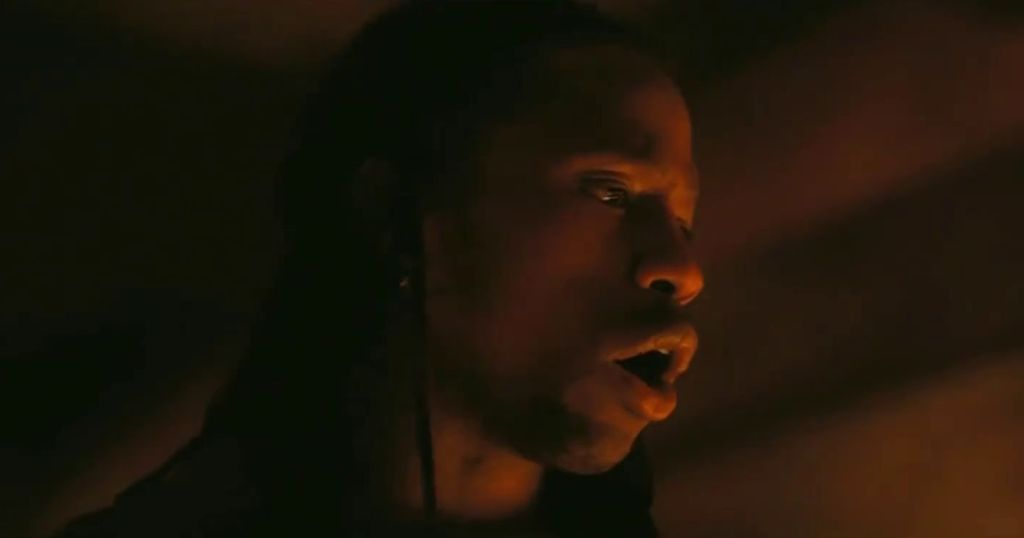
Of course, it’s not always big sci-fi concepts that Nolan uses for information drops. In The Odyssey, the film opens up with an information drop of sorts, with Travis Scott’s bard telling the story of Odysseus. The scene is a great way to incorporate the way stories would have been told in the ancient world, but it also is an excellent way of incorporating a Nolan classic information drop into a film that you might not otherwise expect one in.
2) Women “Haunting” The Hero

If there is one feature you can count on in a Nolan film it is the role of a woman in the life of the hero. Some might note this as the “dead wife” of it all or talk about how a female figure seems to “haunt” the main character, but I think it is really more simple than that. Every Nolan movie features a female character — typically a love interest or former love interest of the primary character — that has a lot of impact on said hero, be it in real life, in memory, or in dreams. In one of Nolan’s earlier films, Memento, it’s the memories of Leonard’s dead wife. In Inception, Cobb is haunted by Mal — quite literally in a sense. In The Odyssey, it’s Odysseus having a nagging feeling that he has someone at home that he loves. There is almost always a woman that somehow has major impact on the emotions and actions of the lead.
The most interesting example of this might be from The Dark Knight, however. We meet Rachel Dawes in Batman Begins, but while she and Bruce do not end up together, she is still a huge factor in his life, his decisions, and even the moment that defines who Batman is to Gotham in The Dark Knight. She continues to loom over Bruce even in The Dark Knight Rises, this time as a result of his grief.
1) An Obsessive Main Character

Every movie’s main character has to have something that drives them. There wouldn’t really be much of a movie if the protagonist didn’t have a driving force. That said, with Nolan’s movie the main characters often take things to a slightly elevated level and are truly obsessed with some aspect of their story. In Nolan’s The Dark Knight Trilogy it is obvious — if you know Batman stories at all, you know Bruce Wayne is very obsessed with his crusade for justice — but this extends to all of Nolan’s films. In Inception, Cobb wants to redeem himself or at least find a way to prove his innocence so he can be with his children again. Oppenheimer is obsessed with his science. In The Odyssey, you see different levels of obsession for Odysseus. He’s obsessed with getting home for sure, but he’s also obsessed with memory — at least until he gets his back.
While an obsessive main character might sound a bit unusual or even off-putting given how frequently Nolan uses this in his films, what is interesting is that because each of Nolan’s movies are different, you get a unique look at how obsession can redeem or destroy a person. It’s a repetitive technique to be sure, but it nets narrative gold.
