


Articles
As We Head Into Helluva Boss Season 3, Here’s What We Know So Far About Each Ring Of Hell
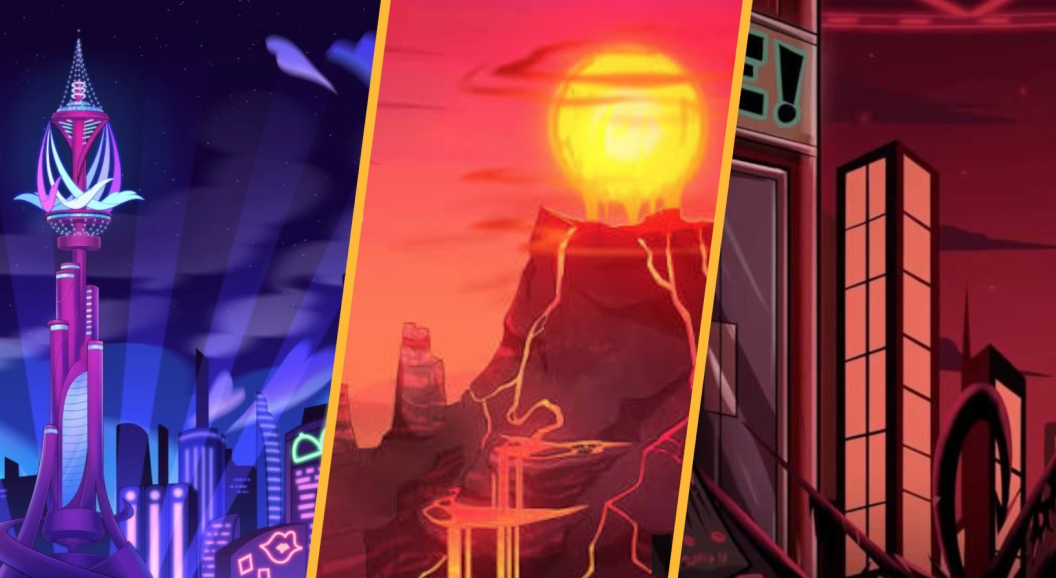
Helluva Boss, which makes up the shared canon known as the Hellaverse alongside its sister show Hazbin Hotel, is a raunchy, gratuitously violent cartoon series set in Hell, about three imps, a hellhound and (as of Season 2’s finale) a disgraced Goetia demon all working together as part of a startup-style business that— under the flaky, barely-competent, temperamental and often deeply inappropriate rule of boss (and show protagonist) Blitzo— travels to the human realm to carry out assassinations on behalf of Hell’s many vengeful souls. However, despite the many colorful and easily recognizable Earth locales that the characters pay visits to on their missions, it is the cast’s travels throughout the Seven Rings of the Hellaverse canon’s Hell that provide the show with its complex and grounded worldbuilding, with each ring having its own unique biome, denizens, and even economy.
Going into the Helluva Boss’ third season, we have already seen from trailers that the show will take us to many, if not all, of the Seven Rings of Hellaverse’s Hell— including one we’ve barely seen any of yet. To get ready and refreshed for the new season, this article is a run-down of each ring— what they’re like, what they do there, and if anyone lives there that may be of importance to the plot.
7. Sloth
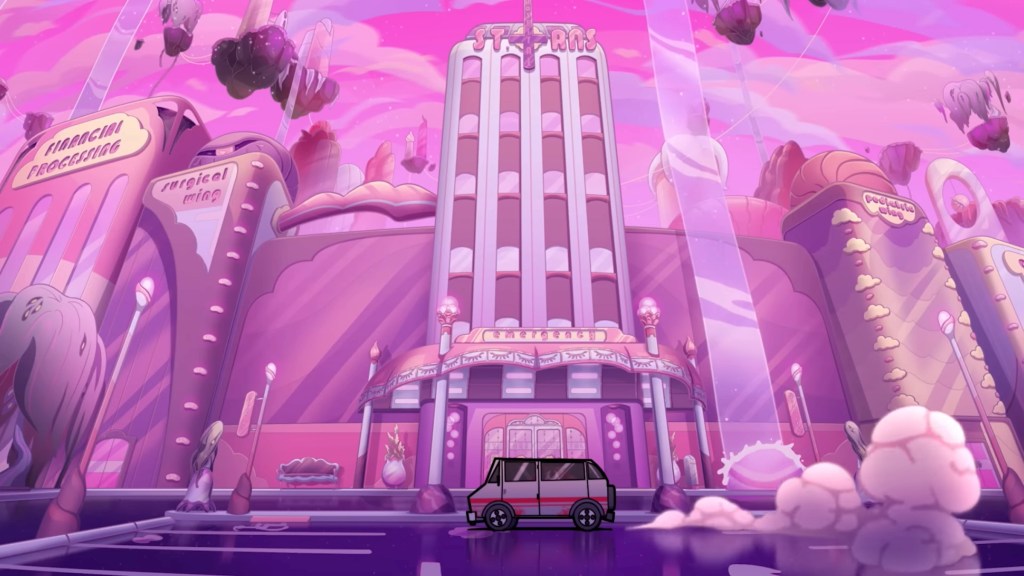
Starting off our list with the lowest ring of the Hellaverse’s Hell, we have Sloth. As can be discerned from the name, each ring on this list is both named for, and embodies, one of the Seven Deadly Sins— although the sin itself may be presented through an uncommon or reimagined lens. The Sloth Ring is a stellar example of this, appearing as a not-at-all-infernal dreamland of lazily drifting clouds, gently flowing floating waterfalls, and muted pinks, teals and purples. The sin illustrated here is based not in laziness or lack of action, but in the choice to sleep life away, comfortable yet insulated and oblivious to the world— here in this cozy, dozy ring, Sloth defined is an excess of rest.
It seems that this definition of Sloth may also cover prescription drug abuse, as Sloth is the medical and pharmaceutical capital of Hell— in fact, Helluva Boss‘ only visits to Sloth so far have been to its various medical institutions, which range in function from primary care to intensive-care units to rehab facilities. The specific connection to prescription drugs is strengthened as most, if not all, medications seen in the show bear the name of the Sloth ring’s ruling Sin (Sin, when capitalized, is the title for the ruler of a given ring in the Hellaverse. The seven Sins together, led by Lucifer, the sin of Pride, make up Hell’s topmost ruling class) Belphegor, and are often advertised as having less-than-healthy effects. Beelzebub has mentioned stealing drugs from Belphegor’s stash, and, given Helluva Boss’ lack of mention of the Sloth ring outside drug- and medical-related contexts, it can be assumed that medication is the ring’s primary export.
Belphegor herself— “Belphie” to her friends— is a gangly, pastel-colored sheep- or goat-like creature with long ears, long wooly hair, multiple eyes, and a candle burning on her head. She wears a simple off-white tunic with a long train and seems to be perpetually on the verge of falling asleep at all times. Her subjects, the denizens of Sloth, do not currently have an official species name, but often appear goat- or sheep-like (though some have a more standard demonic appearance), have candles on their heads, and share their Sin’s slow and sleepy nature.
6. Envy
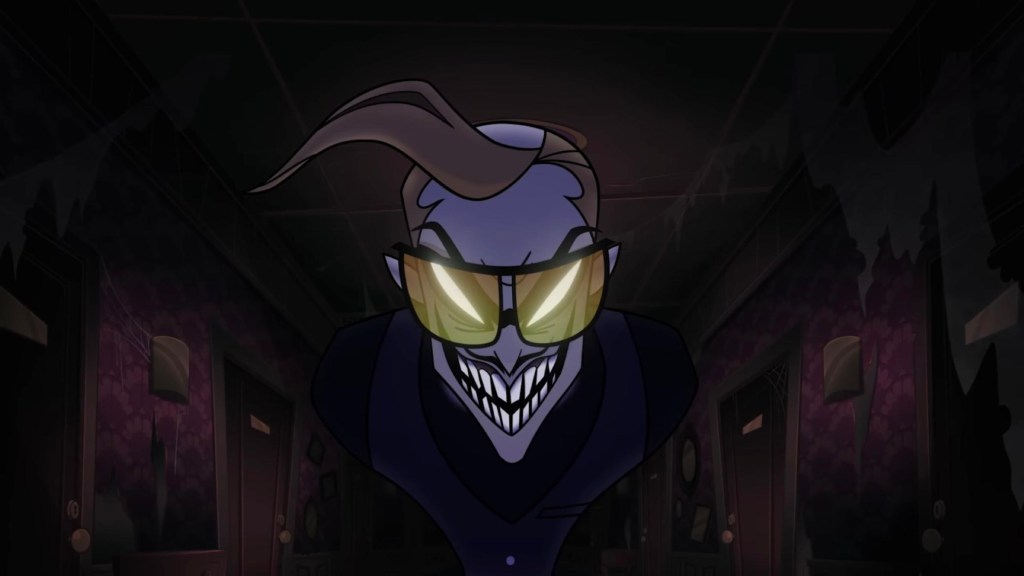
While very little is known about the Envy ring itself, as its appearance in the Helluva Boss Season 3 trailer marks the ring’s first appearance within canon, its fishlike denizens have appeared several times in the series and seem to become prominent players in the future of the Hellaverse as a whole. Glitz and Glam, the twin performers who replaced Fizzarolli as Mammon’s top performers, are from Envy, as were the unfriendly woman and her child sitting next to Blitzo and Loona in “Western Energy”, and given the fish-like nature of the Infestor Demon in the Helluva Shorts episode “Ghostfuckers” (pictured above), it seems likely that he hails from Envy as well— possibly marking the introduction of an Envy-based class of demon that visits Earth with the intention of corrupting humans, much like the Lust ring’s Succubi.
Another notable group of characters from Envy are the ruling Von Eldritch family, made up of the Sin of Envy, Leviathan Von Eldritch— a two-headed combined being that seems to contain two separate consciousnesses— and her son Seviathan. Seviathan has notably been stated by series creator Vivienne Medrano (better known online as Vivziepop) to be the ex-boyfriend of Hazbin Hotel protagonist Charlie Morningstar. It is possible that the shark demons present throughout the Greed ring may also exist in to Envy due to their piscine nature, although this has yet to be confirmed.
In terms of physical layout, economy and exports, we know almost nothing about Envy besides the fact that it is most likely entirely underwater. As mentioned, the trailer for Helluva Boss‘ third season does show a scene in an indoor area that is clearly in the Envy ring— with water visible out the window, sea plants blooming in pots and portraits of the Von Eldritch family on the walls— so we will soon have more information on this elusive marine ring of Hell. Additionally, due to Seviathan and Charlie’s prior romantic connection, Envy is a place to watch as a potential avenue for the long-anticipated Hazbin Hotel x Helluva Boss crossover in Helluva Boss Season 3 Part 2.
5. Lust
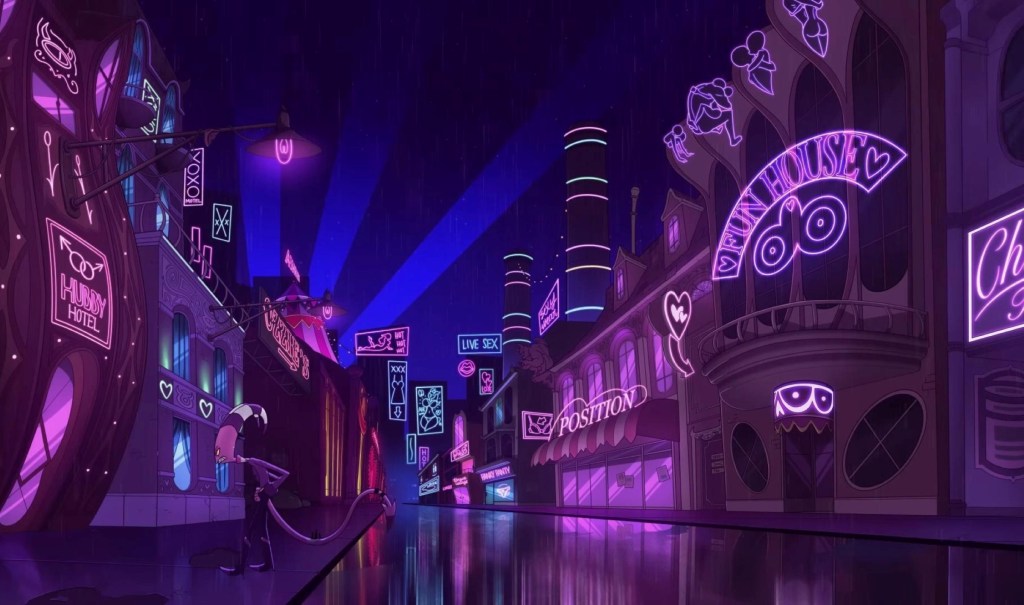
Returning to a ring we are more familiar with, Lust has made one major appearance so far in Helluva Boss, as well as being the setting of several individual scenes. A neon metropolis under perpetually-raining deep indigo skies, the opulent decoration and garish signage of Lust’s many NSFW-focused establishments cast rippling reflections through the puddles that speckle its wide, dark streets. Getting out of the rain, Lust’s interior spaces are brightly lit by a combination of neon tubing and warm golden lights, often appearing to be furnished such in luxe materials as gold, velour, chrome and leather.
While a good portion of Lust’s economy and material exports concerns what the ring’s name suggests, it is clear that the ring’s industries have diversified outwards from their main purpose, with technology repurposed to create advanced animatronics such as the Robo-Fizz duplicates employed by Mammon for his shows as the real Fizzarolli became increasingly dissatisfied with his employments. In fact, the real Fizz, who is the formerly-secret lover of Lust’s Sin Asmodeus, relies heavily on prosthetic limbs that seem to utilize the same technology as the Robo-Fizz line, indicating the utility of Lust’s technology for prosthetic and assistive purposes as well.
While not an economic role in the traditional or material sense, another important function Lust serves within the workings of Hell is as the home ring of Succubi, a beautiful and alluring class of demons who are among the few lower-ranked Hellborn to be able to travel to Earth— an ability granted to them through the use of Asmodean Crystals, magical items that seem to be created by, or at least on the orders of, the Sin himself. While the role of Succubi on earth is to tempt humans to sin, their access to the Mortal realm makes them powerful and influential connections for any lower-ranked demons looking to gain the advantages of inter-realm travel.
As for Asmodeus himself, the Sin is a large, towering creature of vaguely avian or rooster-like appearance, either made of or wreathed in a deep blue-black flame. Dressed in a brightly-colored formal jacket reminiscent of a performer or ringleader, Asmodeus (better known to friends, subjects and probably even enemies as Ozzie) plays his role with a flare to match his appearance, encouraging guests and denizens of his ring alike to engage in Lust— a concept defined in the Hellaverse as desire, fleeting passion and reckless action without true emotional connection or commitment behind it, prioritizing whirlwind one-night-stands, wild experimentation, and risky behavior over stability, togetherness and gentleness.
However, Ozzie’s championing of these values hides that the Sin leads a fairly hypocritical double life due to his relationship with Fizzarolli— not only is a stable romance between a Sin and an Imp highly unusually socially stigmatized due to their positions at opposite extremes of Hell’s hierarchy, Fizz and Ozzie also shares a true and deep romantic bond that defies their caste difference, respective hyper-visible lives in the spotlight (as Fizzarolli was also a performer for Mammon during the majority of he and Ozzie’s relationship), and Fizz’ pain and shame around his disabilities in favor of something soft, sweet and accepting.
Ozzie’s relationship with Fizz makes him the only Sin besides Lucifer to live in direct hypocrisy to his associated values. Aside from Fizz and Ozzie, Helluva Boss’ other most important Lust ring resident is the Succubus Pop Star Verosika Mayday, recurring sometimes-antagonist and Blitzo’s ex-girlfriend. Given that Fizzarolli has appeared repeatedly throughout Season Three’s promotional materials (and may be having some relationship trouble with Ozzie following the events of Season 2’s finale), it is fairly likely that we could see more of Lust this season.
4. Greed
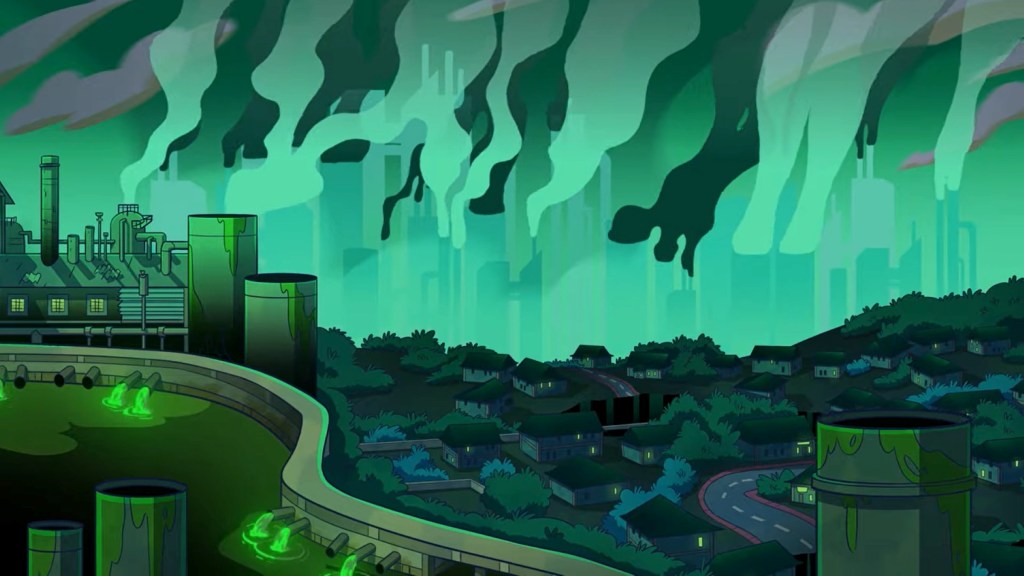
Next up, we have Greed. This one plays it fairly straight. Aside from its sole focus on wealth and capital as the object of the sin, The Hellaverse’s concept of Greed does not differ in any substantial way from broad cultural understandings. The sky, light and hanging fog of Greed is as green as the money its denizens crave. The landscape is a patchwork of decaying cities of towering smoke-belching factories, garbage-strewn lots, and vast overfilled scrapyards, spilling out over dark highways into sprawling, gloomy suburbs of stately and solid gated homes. Occasionally, the tarmac and stone gives way to lakes, or perhaps small oceans, of stagnant olive-green water, which in turn feed the canals that cut through the ring’s industrial areas.
One location in Greed that stands out starkly from the rest of the ring is Loo Loo land, a seedy, slimy, and nearly FNAF-level off-putting theme park run by Green’s Sin, Mammon, with a Robo-Fizz as the Master of Ceremonies. Seemingly the only brightly-lit — even sunny-looking — place in Greed (most likely by will of its powerful owner), Loo Loo land is also the only place in the otherwise sketchy, violent, and gloomy Greed ring that the denizens of other rings would ever go…. or at least, the only place they’d go on legitimate business.
Outside of the more entertainment-focused regions surrounding Mammon’s entertainment venues, Greed is a ring entirely controlled by a self-sustaining society of mafia families and other organized crime. The inhabitants of the ring, mainly imps and shark demons, seem to be engaged in an endless and violent war for turf, honor and cartoonishly large sacks of money, with the only lasting allegiances originating from mafia family ties and maintained through usefulness, personal wealth and absolute loyalty. Interestingly, it seems that the two species of the Greed Ring have something of an internal hierarchy, as while the imps tend to make up the leadership, inner circle, and skilled labor of the crime families, the sharks act more as hired muscle or unscrupulous temporary allies, with no clear bond to any faction outside of whoever is paying them.
Mammon himself, while definitely less gloomy and self-serious than his denizens, is no kinder. A massive, leering jester with glowing green eyes and regalia decked in dollar signs, with a persona somewhere between that of a washed-up stadium rock star and a sleazy manager, Mammon is egotistical, manipulative, crude, childish, and disgusting. Making endless profit from massive multimedia, multi-audience merch campaigns run by off the likenesses of the performers under his sponsorship, Mammon works with Asmodeus and his centers of manufacturing in Lust to churn out robotic duplicates of his favorite performers, which serve as the most luxurious- and questionably ethical- components of the Sin’s branding empire.
While Mammon takes the likeness of a clown, and is considered by demons in-universe to be both the patron and pinnacle of the art of clowning (seemingly a popular and respected field of performance among imps, with popular clowns having rabid fanbases and being lucrative sources of advertising and merch revenue), it is clear that the Sin of Greed only sees the performances for the monetary gain they can provide him, with no attention given to any part of the craft or content that does not directly affect his pocketbook or his ego— a fact illustrated spectacularly when the Sin clapped along happily to Fizzarolli’s angry musical tirade at him, unaware of the lyrics’ meaning until his name was mentioned directly.
In the aftermath of that specific incident, Mammon swore vengeance on both Fizz and Asmodeus, and that fact, along with a scene from the Season 3 trailer where Fizz fights his way through a swarming army of Fizz-Bots, makes a return to Greed seem likely if not certain.
3. Gluttony

Finally moving on from the Hell’s soggier areas, we enter the ring of Gluttony, a bright, vibrant oasis paradise where tall, leafy trees and golden structures tower over warm sandy earth. Gluttony in the Hellaverse is defined as ceaseless and excessive consumption of things and experiences that are pleasurable, but not necessary or substantial, melting away as soon as they are consumed and leaving an appetite for more. Cotton candy is an apt metaphor here, which is probably why it’s the name of the song sung by the ring’s sin, Beelzebub, in which she says, “I’m what you want, not what you need.”
Beelzebub, the self-titled Queen Bee of Gluttony, is a joyful, enthusiastic and charismatic figure, taking the appearance of a Jackal-like creature with the six limbs, wings and stripes of a bee. In place of her middle torso, a lava-lamp like chamber of swirling fire consumes anything she eats instantly. This fire- or lava-like energy also flows through Bee’s brightly-colored hair and tail, combining with her rave-ready outfit and bubbly personality to give the overall effect of a 2000s party girl (in fact, the voice actress for Beelzebub’s speaking lines during Seasons 1 and 2 was none other than 2000s party-pop-sleaze legend Ke$ha).
Honestly, the fact that she was voiced by Ke$ha really tells you all you need to know about both Beelzebub, and how the Hellaverse sees Gluttony overall. Beelzebub keeps her ring lively with a nonstop schedule of raves and parties, supplied with barrels of honey-like alcohol, occasional drugs, and the ever-thematic cotton candy by the Sin herself, who flits around the crowd mingling with the guests and ensuring that everyone is having a good, and decidedly not sober, time. Given that Gluttony in the Hellaverse means pursuing a good time with no limits or inhibitions, Beelzebub, in contrast to her counterpart in Greed, truly wants the best for all the denizens of and visitors to her ring, and is a cheerful, sweet and welcoming host to all.
Gluttony is, as far as we know, populated entirely by Hellhounds, a race of hellborn demons that appear as bipedal, expressive, and stylized (some might say Furry-esque) versions of dogs and wolves, though when fighting they can also take larger and more powerful quadrupedal forms (as exhibited by Loona in Season Two’s finale episode “Sinsmas”). While Gluttony does have a canonically-confirmed role exporting alcoholic beverages (known as “Beelzejuice”, seemingly the same honey-like alcohol that she serves at her parties, possibly similar to real-life mead), it is also very possible that the Hellhounds themselves are, in a sense, an export. The doglike demons can be found working in security and other combat-ready roles in other rings, with examples including Loona’s position as an assassin at I.M.P., and her former crush Vortex’ work as Verosika’s security guard.
While Loona has few close personal connections in Gluttony besides Vortex (a fact which has so far gone unexplained, but may be among the topics explored in the Season 3 Loona-centric episode arc promised by series creator Vivziepop at a panel earlier this year), at least one scene in the Season Three is set in Gluttony, so we will be returning to the Queen Bee’s party ring for sure.
2. Wrath
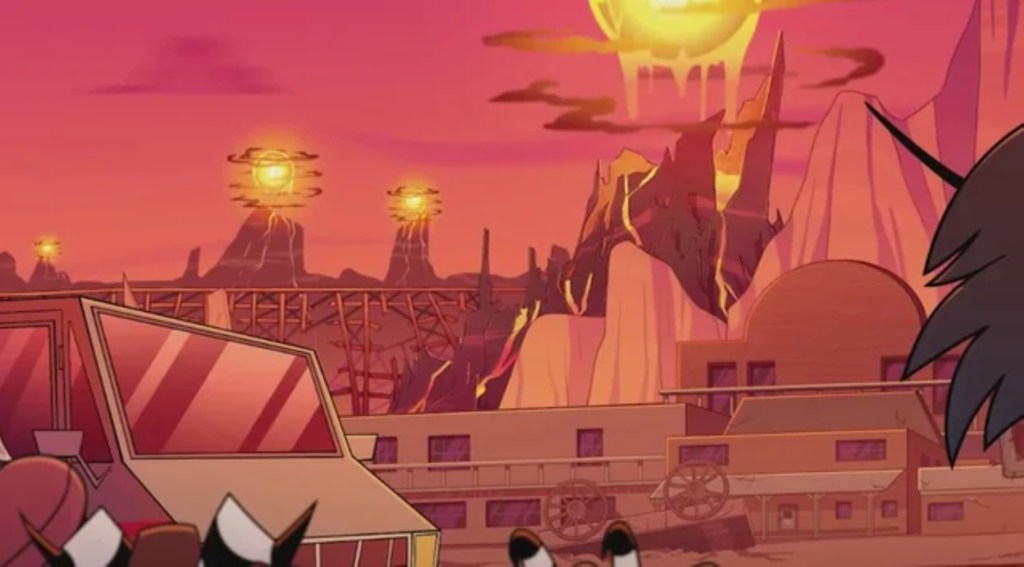
From here on, things are far closer to what most people would picture when they hear the word “Hell”. The vast majority of the Wrath Ring is a seemingly endless expanse of ochre-red barren desert stretched out under a blazing-hot sky. However, the ring must contain some fertile soil, as the landscape is dotted with small farms and ranches, including that owned by Millie’s family. The presence of pumpkins and hogs on Wrathian farms in the episode “Harvest Moon”, and the meat products, bread, butter, eggs, apples, berries, citrus, bell peppers, greens, and more pumpkins seen in the Pride Ring in the episode “Sinsmas”, give us an idea of the type of agricultural goods produced and exported by Wrath, which has the vital role of food supplier to all of Hell. The railroads which can be seen running through Wrath’s many jagged cliffs and cave systems— and which are used for more nefarious purposes by the recurring Wrathian villain Striker— may be a potential route of transport for these goods.
It is also interesting to note that Wrath’s harvest is seemingly dependent on the ring receiving annual exposure to the light of Earth’s moon— a need that, since it is usually provided for by Stolas through skilled use of his family’s Grimoire, may be concerningly unmet in upcoming seasons. Wrath is inhabited entirely by imps, who maintain a farming, ranching or otherwise rural lifestyle in small family homes, with seasonal festivals offering occasional relief and release from the hard work. At these celebrations, it becomes evident why the Hellaverse interpretation of Wrath connects to agriculture. Wrath in the Hellaverse does not necessarily require anger, only the desire to fight, hurt, or kill another living thing.
This desire, and the ability to act on it effectively, are greatly valued in the Wrath wring, as can be seen both at the festivals as they engage in no-holds-barred contests of strength and violence, and in daily life on the farms as they seem to prefer to slaughter their livestock by wrestling them to the ground with nothing but a hunting knife and stabbing them brutally to death. Even outside of the Wrath Ring, the sin of Wrath is performed in this way— on Sinsmas, a holiday where each demon lives out their home ring’s sin to their fullest capacity, Millie and her honorary-Wrathian husband Moxxie celebrate not by expressing or feeling anger, but by cheerfully wrestling, boxing, knocking each other into furniture, and even firing guns at each other.
Lastly, before we move onto the final ring of Hell, let’s look at Wrath’s Sin, Satan. Satan has only appeared once so far in Helluva Boss, in Season 2’s penultimate episode Mastermind, where, in a moment of unexpected accuracy to his real life original Biblical-Hebrew meaning of his name— “The Accuser”— he sits as judge and prosecution over I.M.P’s, and later Stolas’, trial for illegal use of the Grimoire. Bearing the head of a classic red dragon on a massive, muscular, red and scaly humanoid body, Satan is an imposing, authoritative figure whose booming voice, judiciary role, and fiery breath make him inarguably the Hellaverse Sin most in line with both real-life religious, and pop-culture, understandings of The Devil (which is very interesting, given that Satan claims during this episode that he and the other sins lived in Hell before the arrival of Lucifer— although we do not currently know if this is true).
1a. Pride pt.1: Imp City
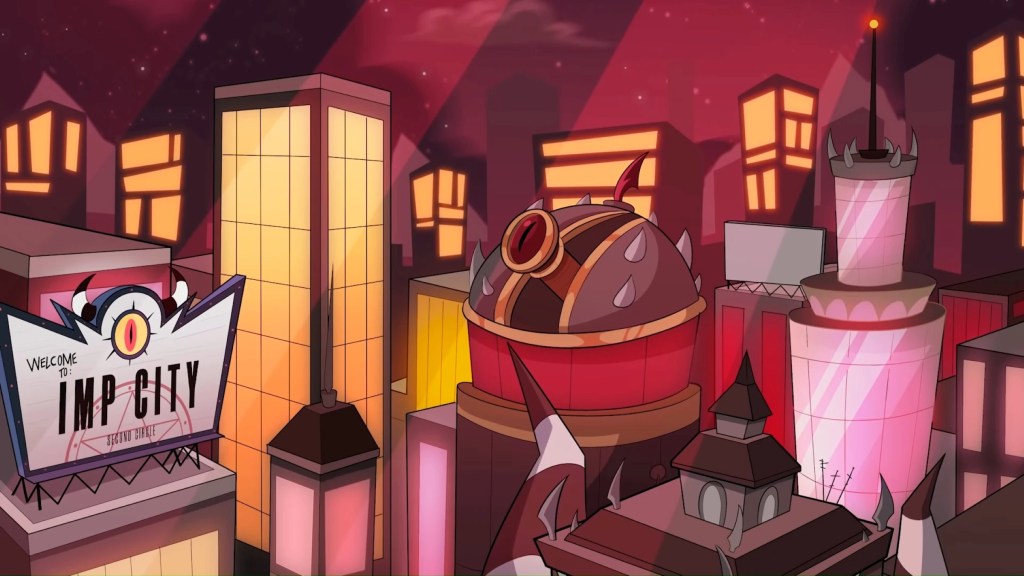
Speaking of Lucifer, we now arrive at the lowest ring of Hell, the Pride Ring. Given that Helluva Boss and Hazbin Hotel canon have confirmed at least three culturally, economically and demographically distinct regions in this ring, it will cover the final three entries on this list. Common between these three regions are the geography and natural features of the Pride Ring, which features dark or red rocky ground, a blood-red sky with Heaven visible in the distance alongside an as-yet-unknown moonlike object, and no native plants or animals except for rats, roaches, and dark rootlike tendrils dotted with glowing red eyes (which may hold more significance to the Hellaverse’s wider lore than simply being creepy flora).
Starting off with the first region of the Pride Ring on this list, and the most important to the plot of Helluva Boss, we have Imp City. This dense urban landscape of mostly drab, rectangular multi-floor buildings is, as its name suggests, inhabited by Imps. As these demons are ranked lowest among Hellborn, the housing and infrastructure of Imp City is generally shabby, with cracked ceilings and grimy sidewalks being the norm. Despite this, Imp City has been shown time and again to be a place vibrant with life, boasting a street market selling fresh produce and other (occasionally stolen) goods, diners, arcades, and even spas and boutique clothing stores. The residents of Imp City most relevant to the plot of Helluva Boss are, of course, the main cast themselves, living in a scattering of apartments near the I.M.P (Immediate Murder Professionals) office.
1b. Pride pt.2: The Goetia
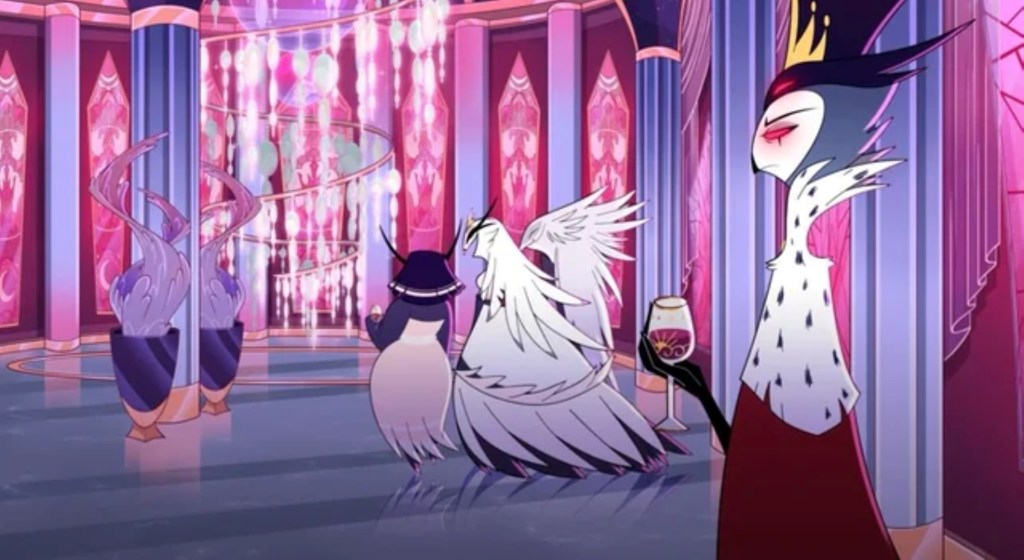
However, one important member of I.M.P is a newcomer to Imp City- Stolas, now stripped of his rank, title, and powers, was once a Prince of the Goetia, a noble, dignified, and status-obsessed class of avian demons with strong magical powers (powers that, while we do not yet have confirmation on this fact or its possible significance, seem to correspond to either celestial or elemental themes) who hold some political sway even among the Sins.
While it seems very likely that the towering palace of the Goetia are located somewhere in the Pride Ring, we do not yet know where, and this question is only made more confusing by the fact that Stolas’ palace seems to be located entirely alone, with no evidence of Helluva Boss‘ other Goetia characters, such as Andrealphus or Vassago, living nearby (at least, not until Andrealphus took over Stolas’ palace). While we know little about the true role of the Goetia in Hell’s governance, nor the locations of most of their palaces, it seems certain that we will be seeing a lot more of them in Season 3— not only is Stolas’ teenage daughter Octavia still effectively hostage in Stolas’ former home under the watchful eye of her scheming mother Stella and uncle Andrealphus, but the Season 3 trailer has also shown that we will be recieving flashbacks to Stolas’ youth among the Goetia, as well as the first full introduction of Vassago. While the Goetia may as yet be very mysterious, they are far from the most powerful demons in the Pride Ring…
1c. Pride pt.3: Pentagram City

Finally, we arrive at Pentagram City— the home of Lucifer Morningstar, the most beaten and crime-ridden section of the final ring, a place rarely seen in Helluva Boss, the setting of Hazbin Hotel, and the only place in all of Hell to actually house the souls of the damned. These demons, known as Sinners, were once humans, who through evil, negligence, and shameful acts done in life, have found themselves spending their eternity in Hell, where their souls take forms inspired in some ironic manner by the sins they committed in life. However, this Hell does not feature the fire and brimstone torments of yore, instead preferring to damn its inhabitants to an eternity to exaggerated versions of the worst parts of modern human existence.
Pentagram city is a hypercompetitive, hypercapitalist, dreary trash-strewn metropolis, where the lightning screams in a human voice, violence is glorified and constant, and even death (by any means other than an angelic weapon) is only a temporary escape— also, given that food and shelter seem to still be necessary for Sinners, and that those things still cost money in hell, it is likely that Sinners also have to find and hold jobs. The afterlife for damned souls in Hell is unstable, unsanitary, and brutal, with those who choose to seek out stability and comfort in the service of more powerful sinners often finding that servitude to be an even worse fate. These more powerful sinners, known as Overlords, were also once human— however, after arriving in Hell, they consolidated power, dethroned rivals, and learned to buy the souls of other sinners through demon deals. With this social and fiscal power also comes magical power, as the Overlords are able to access abilities far greater than any of the sinners. At least three of Pentagram City’s major districts are controlled by overlords including the weapons manufacturer Carmilla Carmine and the trio of entertainment moguls and social influences (and Hazbin Hotel Season 2 villains) known as The Vees.
Ruling over all of Wrath is the final Sin, the Sin of Pride, Lucifer Morningstar. While, due to its formerly-human population embodying a variety of sins, Pride is the only ring where the denizens and culture do not reflects the value of the ring’s associated sin, Lucifer himself embodies a fairly standard interpretation of Pride through his well-meaning, but disastrous, belief that Adam and Eve would be better off having eaten the forbidden fruit. As for Lucifer himself, the fallen angel— who used to be half of Hell’s royal couple alongside Lilith until her mysterious disappearance— is a reclusive and depressed shell of a man.
Both unable to and (mostly) uninterested in physically tormenting sinners, forced to live amid the evidence of the worst human evils he caused by offering Eve the apple, Lucifer spent most of his eternal life locked in his workshop in a vain attempt to relive some of the creativity and joy he experienced as one of the Angels in charge of Earth’s creation— at least, until his hope— and his social life— was restored when his daughter with Lilith, Princess Charlie Morningstar, began her work on Pentagram City’s final notable location: the Hazbin Hotel. The hotel offers sinners a chance at entrance into Heaven, and, perhaps more importantly, a safe and stable place to stay while they work towards that goal. The hotel, whose eponymous show is approaching its own third season in 2027, has already amassed its own colorful cast of characters, and, given the recent news of a planned crossover, fans would be well-advised to keep a sharp eye out for them in Helluva Boss season three.
