


Articles
After 44 Years, This 4-Word E.T. Quote Is Still One of Sci-Fi’s Most Heartbreaking Lines

There are movie lines that become famous because they are clever. Others become part of pop culture because of their relevance and trendiness. And then there are the lines that ultimately define an entire movie’s theme in a powerful, unforgettable way. “E.T. phone home” belongs to the last category. Four simple words, spoken by a stranded alien, became a symbolic motif for the very notion of homesickness itself.
“E.T. phone home” might sound like just some simple request. But Steven Spielberg and his classic movie understood something much more painful about friendship, childhood and having to let someone go. E.T.’s desire to go home is heartbreaking because Elliott has become his home on Earth. E.T. doesn’t say, “I want to leave.” He doesn’t say, “I can’t stay here.” He doesn’t say, “I’m scared.” He doesn’t say, “I miss my planet.” He doesn’t say, “I’m sorry, but I don’t belong here.” Essentially, he says all of those things and more.
The Connection Between a Boy and an Alien
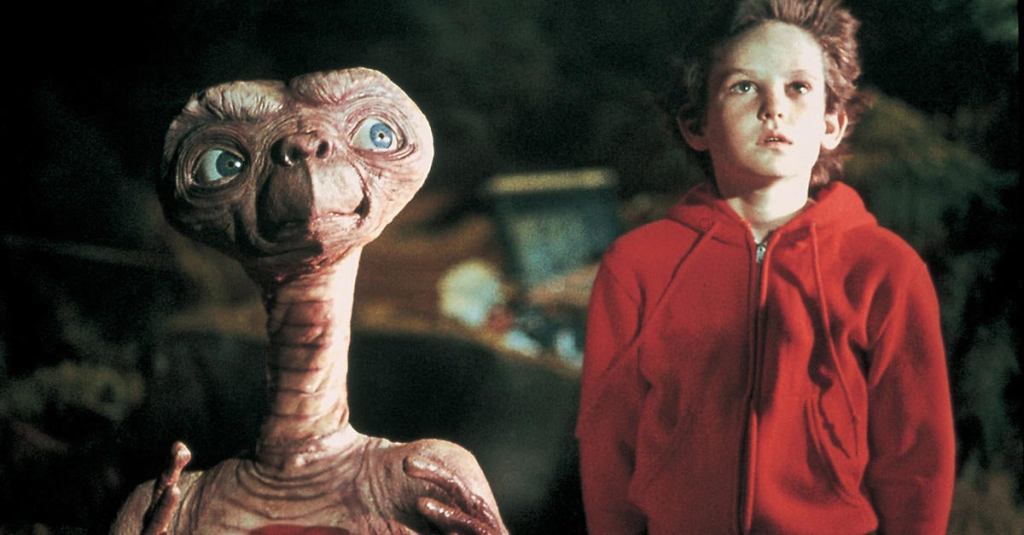
Spielberg has many sci-fi movie hits, but E.T. engages audiences with a story about an alien and a boy forming an almost supernatural bond. E.T. is a stranded alien who has been separated from his family and his home planet. Elliott is a lonely boy who discovers an unexpected friend who he starts to deeply care for. Their connection is so powerful that it seems like the distance between Earth and E.T.’s home almost disappears. Elliott has become E.T.’s family and home on Earth—even though the little alien could never stay there.
The first time E.T. says he needs to go home, it’s a moment that also solidifies Elliott and his younger sister Gertie as the alien’s family. Even the older brother Michael shows up. Although Elliott and Gertie are excited that they can understand what E.T. is saying, Elliott starts to whisper back the words as he begins to realize: Sometimes loving someone means accepting that they don’t belong with you. And that’s why the line is so heartbreaking. E.T. likes Elliott, but that doesn’t mean he should stay. Elliott likes E.T., but that doesn’t mean he gets to keep him.
E.T. Phone Home in the Modern World
Phone technology has obviously aged since 1982, but the idea of phoning home hasn’t. In the ’80s, calling home meant physically finding a landline telephone. It was a more involved task that could also prove to be challenging. When making a phone call, you were generally limited to staying within the length of your phone’s cord. Although cordless phones were already available and becoming popular in the early ’80s, mobile phones were still large, expensive, and far from commonplace. Today, we can video-call someone on the other side of the planet instantly. And yet people still understand the feeling behind the line. Technology has made communication easier without eliminating the homesickness E.T. must have felt, along with Elliott’s sadness.
We’ll never know the actual thoughts of E.T., but his character gives us an unusually simple version of a complicated feeling. E.T. is separated from his family, finds an unexpected connection with Elliott, and eventually has to choose between staying on Earth or returning to where he belongs. The spaceships and special effects make it memorable, along with the powerful soundtrack, but the separation is what makes it painful. Spielberg isn’t really asking us to mourn an alien. He’s asking us to recognize what it feels like to say goodbye.

We normally spend our lives trying to make “home” a permanent place. E.T. explores something more painful: home can be a person, a family, a childhood, a planet—or somewhere you can no longer stay. And sometimes the hardest thing about loving someone is hearing them say they have to go home. Fortunately, after 44 years, Spielberg also answered one of the most important questions about E.T. and Elliot’s goodbye.
The point of E.T. is not to make us believe in aliens. The most powerful theme of the movie is soaking in the emotions of bonding and having to say goodbye. Spielberg’s greatest trick wasn’t making an extraterrestrial alien just look real and feel believable. It was convincing audience to care about the little guy and experience how his desire to go home feels painfully human.
