


Articles
53 Years Ago Today, Hollywood Reversed One of Its Most Controversial Cancellations & Brought Back A Fan-Favorite Sci-Fi Series In A Way No One Expected
The screen is dark for a mere second. Then, it shifts, dozens of white dots and blue lines illustrating the vastness of space popping up. The familiar chimes of a theme song plays, and any doubt of the series about to unfold is dismissed with four simple words: “Space, the final frontier”. The voice narrating is William Shatner, the voice of Captain Kirk, known from the Original Series, and brought back for this follow-up. Yet, when the intro ends and the program starts, it isn’t a dramatically lit high definition camera shot of William Shatner we see.
No, four years after Star Trek’s cancellation amid syndication success and fan outcry, the series was brought back not for live action but as an animated series. The first episode of Star Trek: The Animated Series aired fifty three years ago on September 8, 1973, challenging viewers to grapple with the return of a show they loved — an outcome that many fought for — but in a form they didn’t expect. The show may not be commonly discussed today, but back in 1975, it won a Daytime Emmy Award for Best Children’s Programming.
How Star Trek: The Animated Series Compares to The Original Series
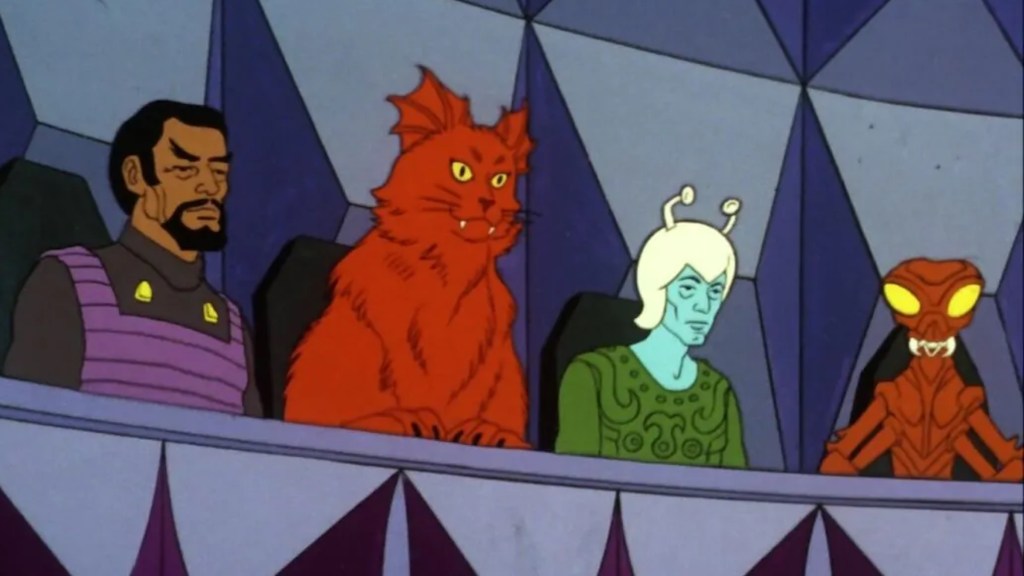
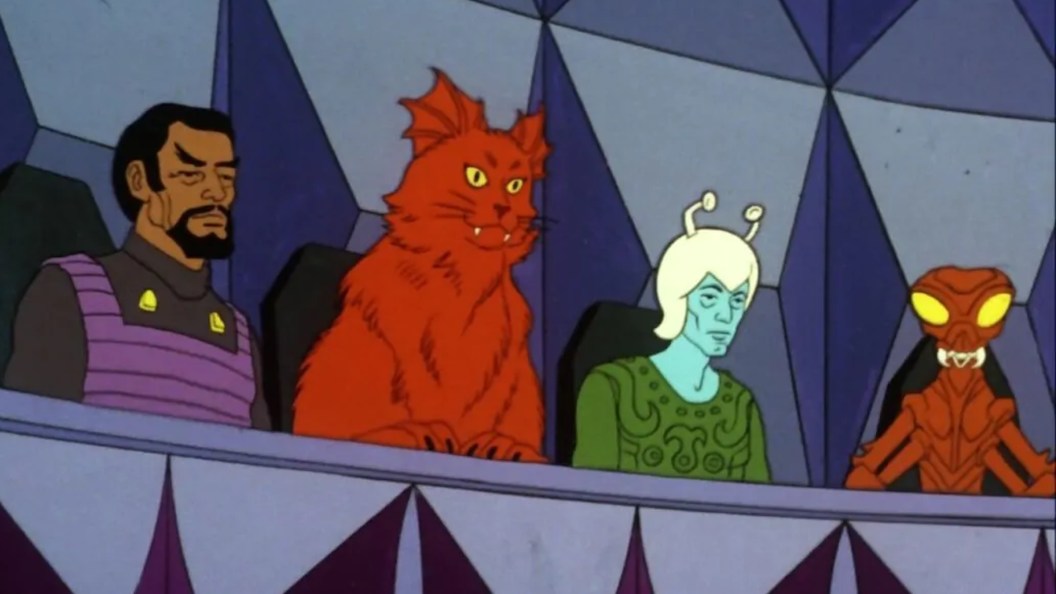
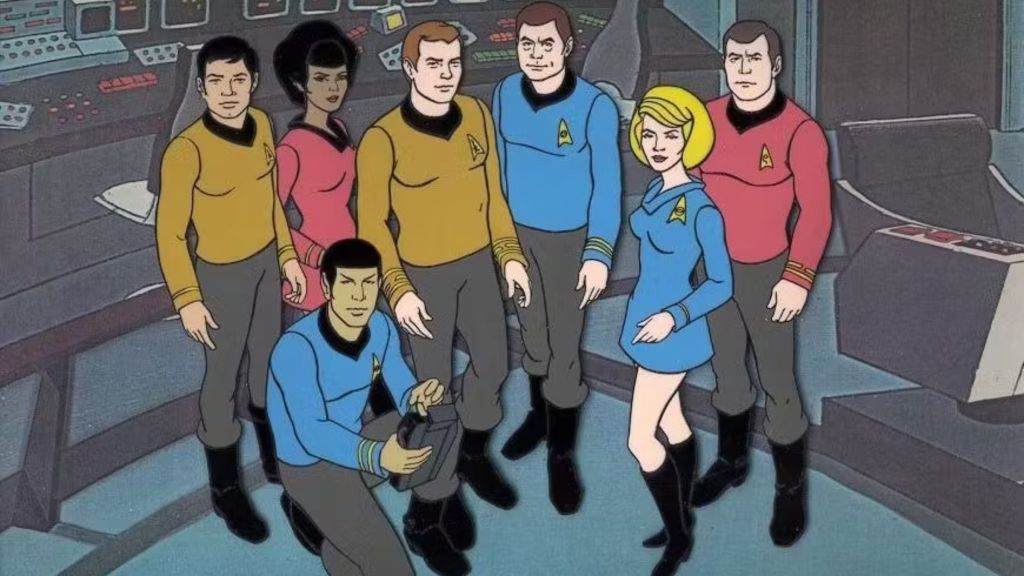
To get it out of the way, the animation in The Animated Series is nothing to write home about. It gets the job done. Kirk, Spock, Bones, Uhura, Sulu, and Chekhov are still recognizable, even if the show does take away Spock’s eyeshadow. The animated artform allows for greater alien representation from an orange alienoid appearing in the first scene of “Beyond the Farthest Star” — the first episode of the series — as a minor character of the crew onboard the Starship Enterprise.
Beyond the animation, Star Trek: The Animated Series is able to keep continuity. The intro that begins each episode is the same, keeping the crew on the Starship Entership and aboard the five year mission that they started in the original series. In addition to Shatner, Star Trek: The Animated Series also had Leonard Nimoy, Deforest Kelley, Michelle Nichols, and George Takei reprise their roles. Additionally, many of the creatives behind the original Star Trek returned such as creator Gene Roddenbery and writers David Gerrold and D.C. Fontana.
Unlike future continuations and reprisals such as Star Trek (2009) or Star Trek: Strange New Worlds, Star Trek: The Animated Series isn’t preoccupied with reintroducing itself to an audience. Likely, given its proximity to the original show’s cancellation back in 1969, it expects the same audience to tune in, an audience that is already familiar with the dynamics between the cast and the show’s premise.
The “Yesteryear” Episode Is Considered One of the Best
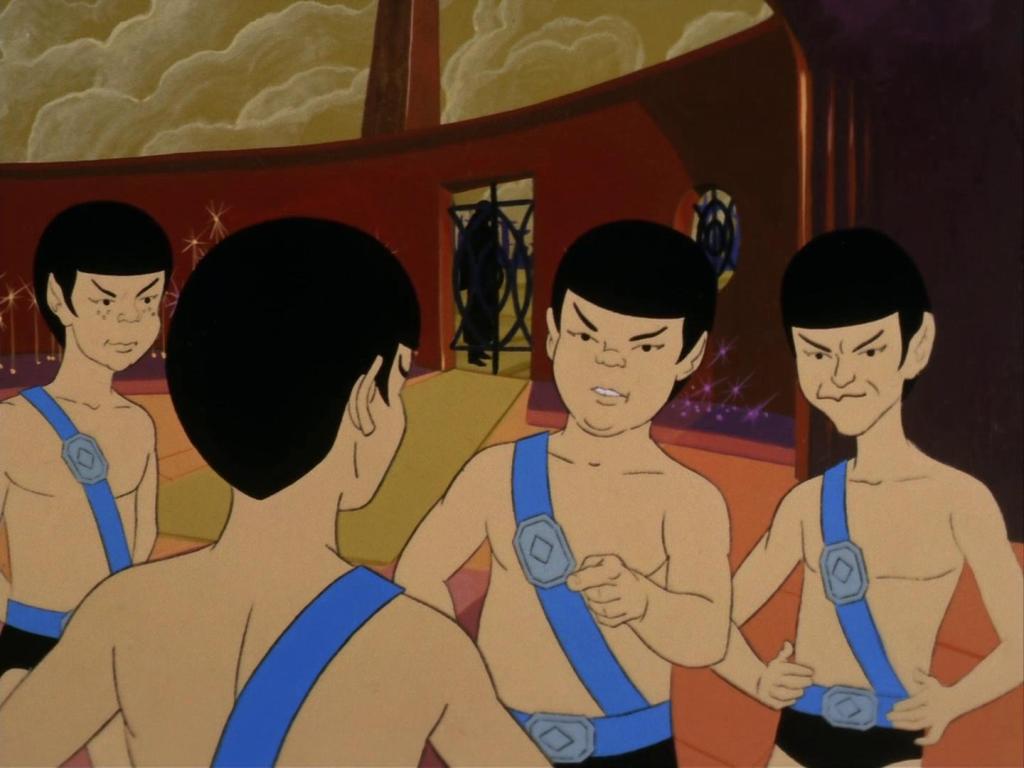
The show’s second episode “Yesteryear” is a good example of keeping continuity while expanding on lore presented in the show – and is largely considered one the series’ best episodes. Following Kirk and Spock traveling through a time vortex, they return to the Enterprise to find that nobody remembers Spock. His position on the crew has been filled by Thelin, an Andorian, and Starfleet Records reveal that in this altered reality, Spock died at seven years old from a Vulcan maturity ritual known as the Kahs-Wan. After recalling a cousin who resembled his adult self, Spock chooses to return to the time vortex and fix the timeline by saving his younger self.
By spending most of its runtime on Vulcan set in the past, the show allows audiences further insight into the planet, beyond the mating ritual focus of “Amok Time”. Not only do audiences see Spock’s childhood home, greater detail is spent on the landscapes of Vulcan, including the desert where Spock saves his young self but loses their pet i-Chaya.
You can check the episode out below:
Like the many iterations that would follow it, the tension in the episode between young Spock and Sarek is Spock’s reaction to the other Vulcans at school bullying him for being part human. Sarek believes Spock too emotional and informs him that one day, he must choose between his Vulcan and his Human side, and that choice will determine his life.
Unlike the iterations that follow, it is not Spock’s choice that gets the narrative emphasis but rather a conversation between Spock, while posing as a family cousin, and Sarek. Sarek is grateful for Spock saving his son and asks if there’s anything he can do to repay him. Spock requests that Sarek “try to understand your son”.
Is The Animated Series ‘Real’ Star Trek?
While “Yesteryear” feels akin both to the Original Series and the various Star Trek projects available for streaming today, there was pushback at conventions from fans. In a 2019 interview with TrekCore, authors of the Official Guide to Star Trek: the Animated Series debunked the misconceptions that had come up around the show. One of the authors, Aaron Harvey, found that fans at conventions argued that The Animated Series wasn’t “real Star Trek” — despite retaining the same cast and crew. He likened the fan response as “so much like listening to people talk about Star Trek: Discovery or Star Trek: The Next Generation”.
Fan pushback may perhaps be an even stronger part of Star Trek continuity than the show’s lore itself. Yet, it is this discussion that keeps the show alive. Star Trek: The Animated Series ran for 22 episodes between 1973-1974. Like with its previous cancellation, Star Trek wouldn’t stay in creative limbo for long. Only five years later, Star Trek would once again be reimagined with Star Trek: The Motion Picture.
Throughout the 1980s and 1990s, there would be five more films with the original cast, and fan reactions to the various films would vary. Growing up, I heard the rule that the even number films were great while the odd number ones sucked, which only spurred my interest in watching and discussing them more.
Do you consider Star Trek: The Animated Series to be real Star Trek? Why or why not?
