


Articles
3 Games From the 2000s That Have Aged Incredibly Well

Time does not walk gently through video games a lot of the time. Controls stiffen like old joints, visuals lose their spark, and ideas that once felt revolutionary start to feel like artifacts from stranger timelines. The 2000s were especially chaotic, a decade full of bold swings and strange experiments, which means plenty of games did not survive the long trip into the present.
And yet, a few of them feel almost untouchable. Not preserved in amber, not carried by nostalgia. You pick them up and they respond as sharp and confident like they never left the modern day. These are the games that refuse to age. That still hum with lively rejuvenation in with the same way they always have, like time itself forgot to claim them.
3. Star Wars Jedi Knight 2 – Jedi Outcast

Star Wars Jedi Outcast drops you into the boots of Kyle Katarn in one of his final modern day Star Wars adventures, which began with the Dark Forces series. It came with the kind of confidence most licensed games only pretend to have. Today, its clear that time has not affected it much, as it understands the rhythm of Star Wars on a deeper level than almost every Star Wars game that came after it.
While the game’s graphics have certain aged, they have aged rather gracefully, still looking solid and doing what they need to do to convince you this is a full-fledge 3D Star Wars experience. What keeps it fresh is how effortlessly it handles the fantasy. Combat feels weighty without dragging along baggage from other projects, and every swing of the lightsaber carries purpose full of impact. Blaster bolts snap toward you and are sent flying back with a flick of the wrist, while Force powers inject just enough chaos to keep encounters exciting. There is no clutter here, no unnecessary noise, just a clean, focused system that understands exactly what it wants to be.
Holding it together is just how well the gameplay has remained modern in itself. Swinging your lightsaber remains a fluid endeavor and utilizing the force for all manner of obstacles and conflicts is still highly engaging. Movement feels responsive as your acrobatically leap around the battlefield with precise ease. The Star Wars atmosphere still wraps around you like a familiar cloak. Even now, since its release on Steam in 2003, the game retains a “Very Positive” review, and for good reason. The game does not beg for attention or try to reinvent itself for modern tastes. It stands firm, confident in its design, and continues to deliver one of the most satisfying Jedi experiences ever made.
2. World of Warcraft
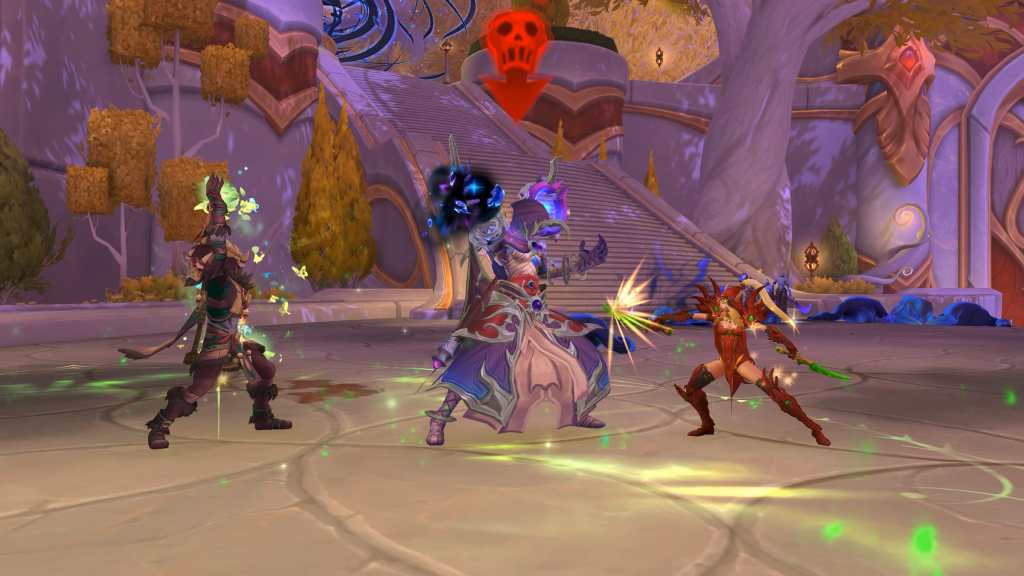
When World of Warcraft opened its flood gates back in 2003, it pretty much swallowed entire lives whole. Azeroth, the game’s setting and a huge open world, stretched endlessly in every direction, filled with danger, wonder, and the constant hum of other players chasing their own stories. Early days were defined by long treks and the simple thrill of existing in a world that felt bigger than anything that came before it. Logging in felt less like starting a game and more like stepping into a second reality.
Decades have passed since those early discovery days, and while that thrill of discovery is almost nonexistent in modern World of Warcraft the game still gets expansions stacked on top of one another. Everyone time a new one comes out, entire systems are reshaped again and again. Through all of that change, something essential remained untouched. The world still breathes. Quests still pull players forward with persistence. There is a rhythm to it all, a cadence that feels familiar even as everything around it evolves. It adapts without losing its voice.
Today, over two decades later, it still stands as the most relevant MMO on the market, not through stubbornness, but through a strange kind of resilience. New players arrive and find something welcoming, while veterans return and feel echoes of what once hooked them. It has aged by growing, not by fading, and that growth keeps it firmly planted in the present while carrying the weight of its past with ease.
1. Half-Life 2

Half-Life 2 arrived like a revolution, with a namesake that was already so ridiculous famous, that it unfolded its brilliance without ever needing to raise its voice. Today, that fame has only grown more monstrous, as the the industry as whole waits fervently for a sequel that may or may not ever come. Even so, Half Life 2 is a game that tells its story as you move through it, never breaking the illusion, never pulling you away.
Physics was one of its biggest selling points, offering the science as a legitimate weapon type for one of the first time in gaming history. It became a language in which futures games would pull many lessons from. Environments themselves become tools and puzzles, with every moment feeling deliberate, like it was placed exactly where it needed to be. What makes it endure is how cleanly everything fits together. The pacing never stumbles, the interactions remain intuitive, and the world continues to feel grounded despite its many surreal edges.
Its influence stretches far beyond its own walls. Entire genres carry its fingerprints, and countless games have borrowed pieces of its design in an attempt to capture that same magic. Mods exploded from its foundation, new ideas took root, and entire experiences were born from what it started. Yet even with all that legacy swirling around it, Half-Life 2 remains strong on its own, a complete and compelling experience that still feels right the moment you step back into it.
What do you think? Leave a comment below and join the conversation now in the ComicBook Forum!
